

How the Lens Affects Portraits

A lens is one of the most important parts of a camera. It determines how wide or narrow the field of view will be, how the perspective will look, how much you can magnify the subject, and what the background blur will look like.
At first glance, choosing a lens can seem complicated: 24mm, 35mm, 50mm, 85mm, 70–200mm — what do these numbers mean and which option do you need? In reality, it's much simpler if you understand the concept of focal length.
What is focal length?
Focal length is measured in millimeters (mm) and affects the field of view of the lens.
Simple rule:
shorter focal length → wider field of view;
longer focal length → narrower field of view and stronger magnification.
For example, a 24mm lens covers much more space than an 85mm. That's why 24mm is good for landscapes, architecture, and travel, while 85mm is often used for portraits.
It's important to understand that focal length is not just about "magnification." It also affects how perspective looks. With a wide-angle lens, the foreground can appear larger and distant objects smaller. Long-focus lenses, conversely, visually compress space.
One model. Nine lenses. One frame
The model sat still, her pose didn't change. The photographer stepped further back each time and used a longer lens — so the face remained the same size in the frame. The only variable here is the distance between the camera and the model, and the lens focal length simply compensates for this distance.
At 16mm, the camera was just a few tens of centimeters from the face — the nose and forehead were closer to the lens than the ears and jaw, so the perspective "puffed up" the center of the face. At 150mm, the camera moved back several meters — all points of the face were at almost the same distance from the lens, so the proportions leveled out and the features compressed.
This is why "portrait" lenses are not a whim but physics: they force the photographer to maintain a distance that best captures the human face.
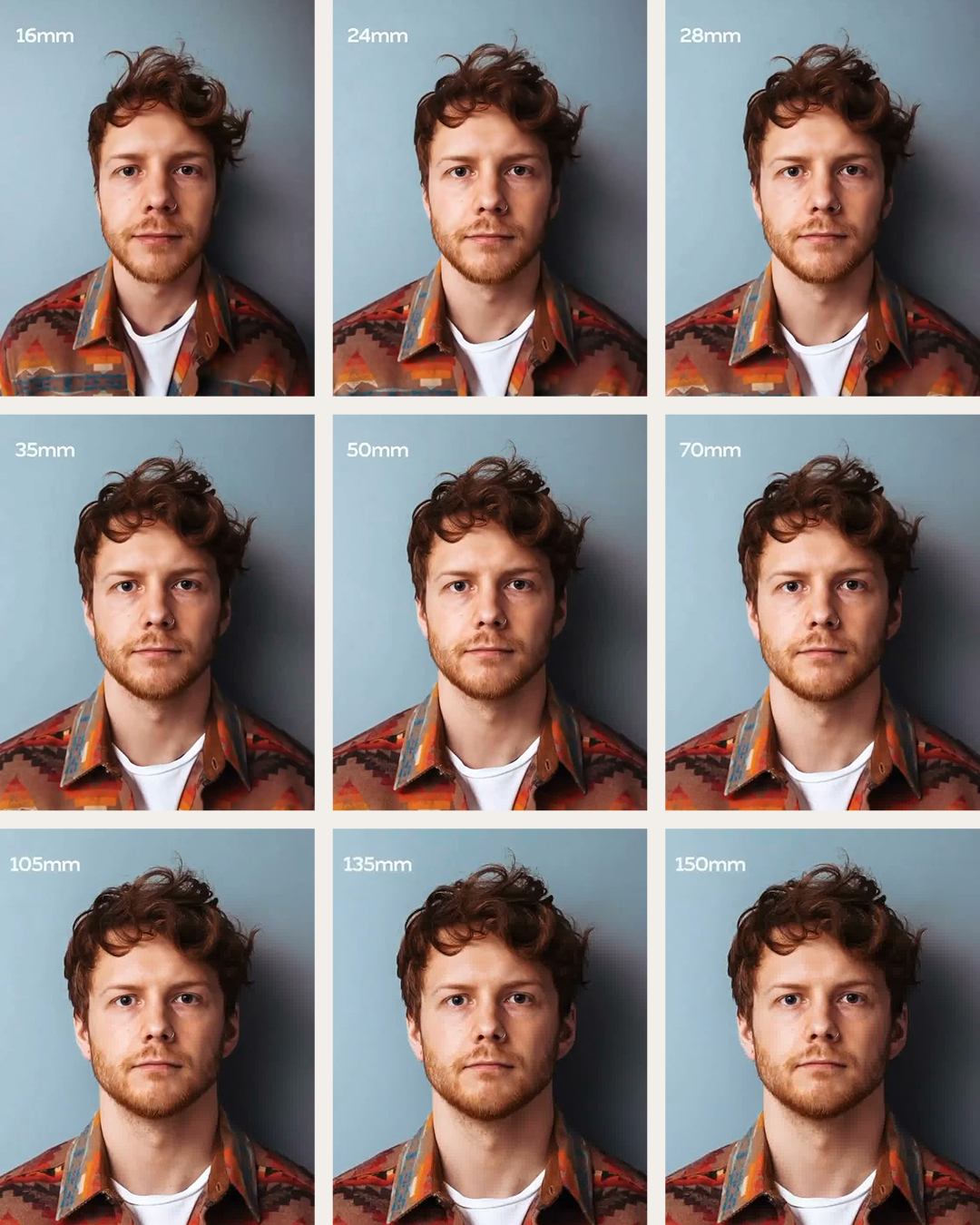
Wide angle (14–35mm)
Stretches what's closer to the camera — the nose appears larger, ears move back. At 14–24mm, distortion is strong, close-up portraits are rarely shot this way. Closer to 35mm — softer, suitable for a portrait with surroundings. The main strength of this range is the space around the person, not the face itself.
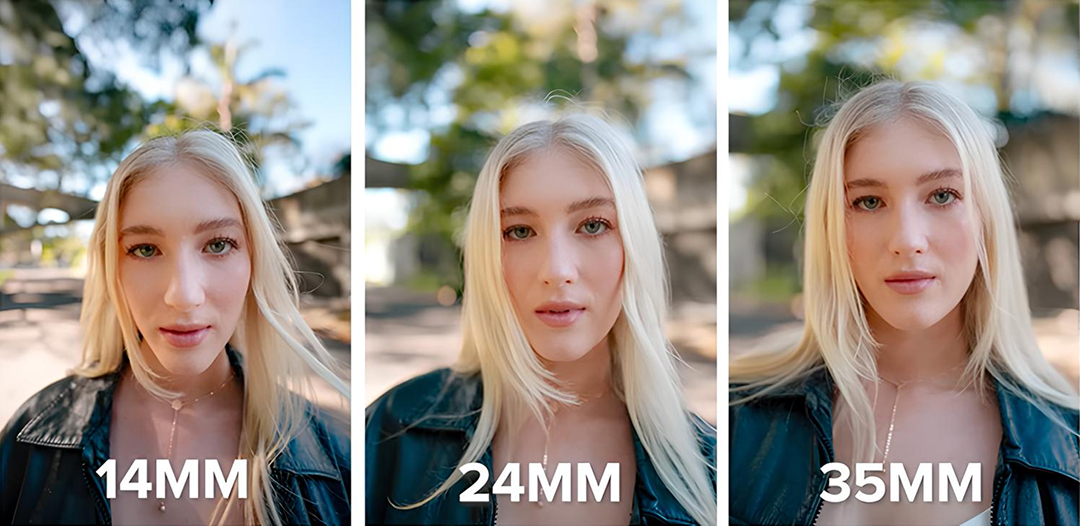
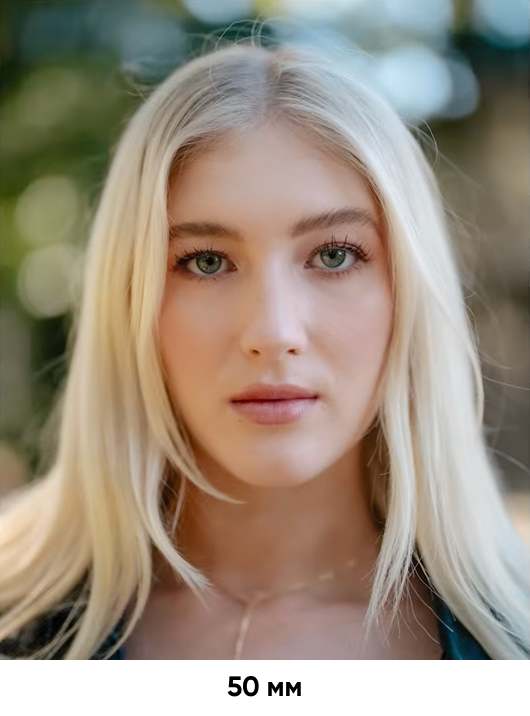
Standard (50mm)
Facial proportions look natural, almost as the human eye sees them. A universal choice when you don't want an "effect" but the truth.
Portrait (85mm)
A classic of the genre. Compresses facial features, makes the face narrower and more refined, provides good background blur. Standard for studio portrait.

Telephoto lens (105–135mm)
Even stronger compression, the background almost disappears into blur. Perfect for candid shots from a distance — weddings, photojournalism, when you don't want to invade someone's personal space.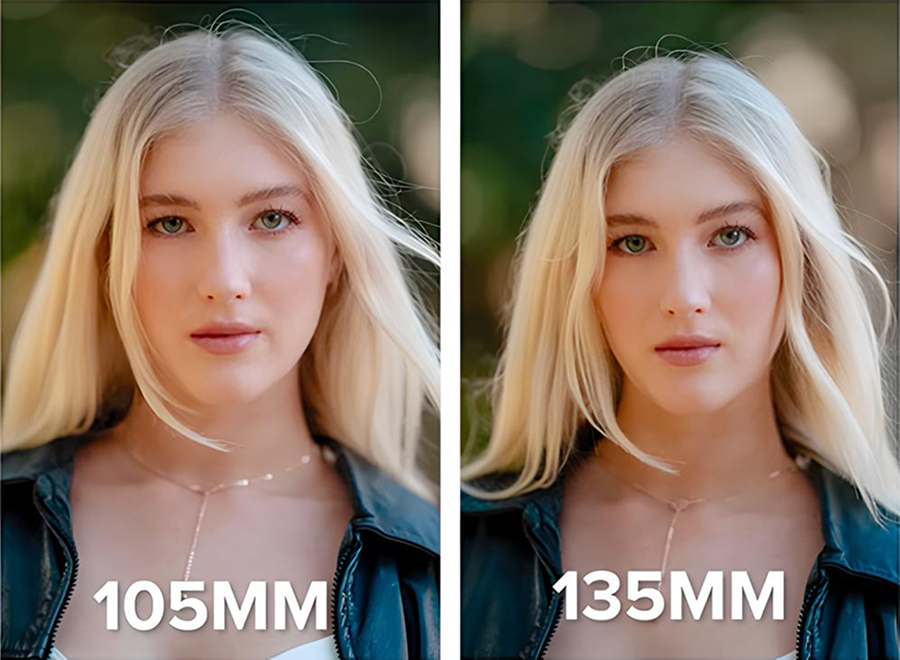
Which lens should you choose?
The best choice starts not with the brand, but with what exactly you photograph.
For landscapes and architecture, look at 14–24mm.
For travel and street photography, good universal options could be 24–35mm.
For everyday photography — 35 or 50mm.
For portraits — 50, 85 or 135mm.
For sports and wildlife — 70–200mm and longer focal lengths.
And if you need one lens "for everything," consider a versatile zoom, such as 24–70mm or 24–105mm.
Most importantly, don't look for the "best" lens, but find the one that matches your photography style. Sometimes a simple 35mm or 50mm can give much more for a photographer's development than a large set of expensive lenses.